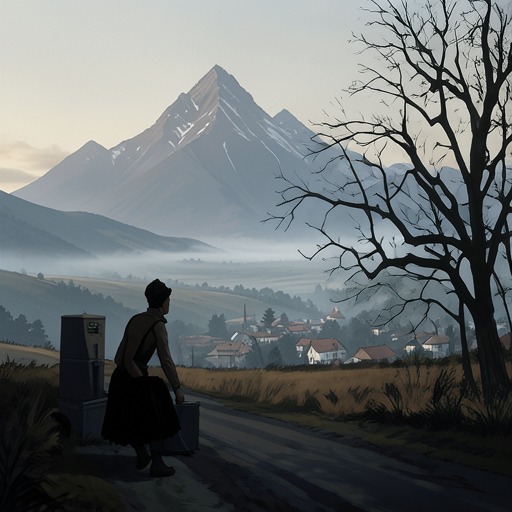
Great Mountain Range of Dagonaut and Unauwen
De brief voor de KoningThe Great Mountain Range of Dagonaut and Unauwen is a physical threshold on Tiuri and Piak’s route between Unauwen and the lands to its west, and a political marker of Unauwen’s reach. Its passes can be crossed, but the glacier, exposed terrain, and approaching autumn rains make passage dependent on the route and the season.
Setting and Political Geography
The range marks the extent of Unauwen’s territory in a history of changing borders. The Rainbow River had once served as the kingdom’s boundary; later, Unauwen’s rule extended across the land as far as the Great Mountain Range. The old crossing tradition nevertheless endured: travelers crossing the river owed a toll to the king, whose appointed toll lords had once guarded the river against incursions. The range therefore appears not only as a natural barrier but as the far edge of a realm whose political arrangements outlasted an earlier boundary.
The mountains also figure in Ardoc’s account of the danger from Eviellan. He says that the attackers would not get beyond the Rainbow River while the toll lords remained there, and that Dangria would resist as it had in earlier sieges. His remarks distinguish the range as Unauwen’s territorial extent from the river as a defended line of approach.
The Pass and the Journey into Unauwen
On the outward journey, Piak identifies a pass reached by crossing a glacier and going beyond a ridge; from there, Tiuri would be able to see the Unauwen Realm. The route is visibly above the tree line, among bare, rugged ground, with a glacier extending toward the valley. Piak expects they can reach the pass the next morning and ties the travelers together with a rope before they continue. The crossing is thus presented as a guided passage through difficult terrain, not an open road.
The range also gives their journey a clear directional threshold: on one side lies the country they have traversed; beyond the ridge lies the realm toward which Tiuri is carrying his mission. Its significance comes from both the physical effort of the crossing and the destination revealed from the pass.
Return Across Familiar Ground
Later, Piak and Tiuri approach the mountains again while traveling with Ardoc. The mountains draw closer as they travel, and Piak considers leaving behind his mail shirt to lighten the climb, though he refuses to abandon his sword. After spending the night at Ardoc’s home, they take leave of their last acquaintance west of the range and begin climbing. Once past Filamen, Piak says he is back on familiar ground and feels more at home there than in the country they have just visited. They also call on Taki and Ilia, who welcome them with some surprise.
Piak is keenly aware of the season: the autumn rains will soon begin, making the crossing difficult. They reach the pass the next day and spend the following night in the cave beneath the seventh rock. This time the weather is better than on their previous crossing, and much of the route leads downhill. Piak greets familiar places with pleasure, though he grows quieter as they approach the hermit’s hut.
Narrative Significance
The range recurs as a threshold that Tiuri and Piak must cross in both directions. On the first passage, it stands between Tiuri and the realm he must reach; on the return, it leads Piak back toward places he knows and regards as home. The pass, glacier, rope, seasonal warning, and shelter beneath the seventh rock give this political boundary a practical scale: movement across it depends on guidance, preparation, and conditions on the route.